
Leadership and
management


Nowadays, The King’s Fund is known for both its work in health and care policy and in leadership and organisational development. While the Fund’s initial purpose was to financially support London’s voluntary hospitals, this scope started to expand within the first 20 years of the Fund’s existence. The start of its work on the health and care workforce reflected the general movement towards professionalisation in the caring professions. The start of the 20th century brought the establishment of the General Medical Council and Royal College of Nursing as well as key pieces of legislation such as the Midwives Act 1902 and the Nursing Registration Act. These changes represented a sea change towards standardising the education and training of the caring professions as well as introducing professional regulation measures such as registration.

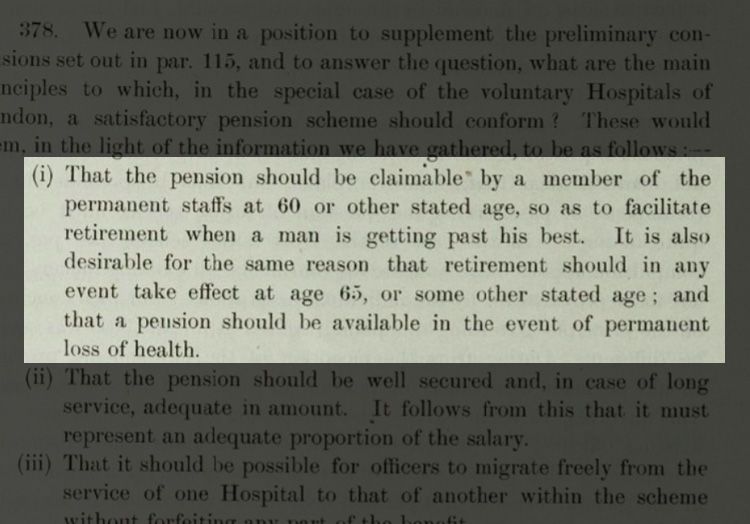
Pensions for hospital officers and staffs : report of a sub-committee of the executive committee (1919)
Pensions for hospital officers and staffs : report of a sub-committee of the executive committee (1919)

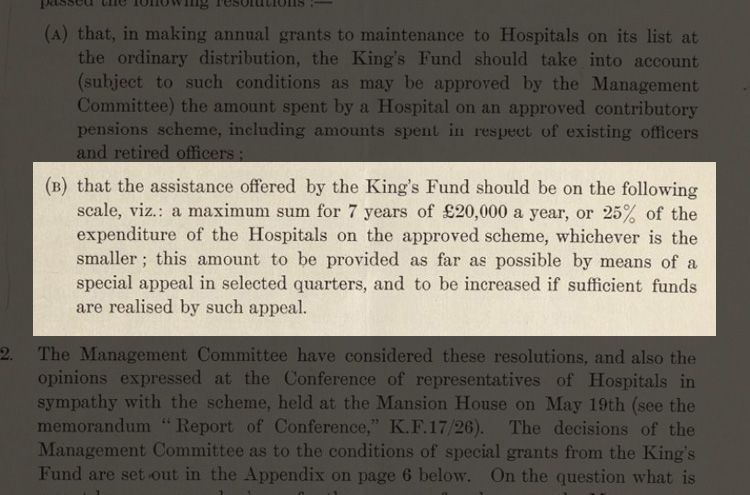
Pensions for hospital officers and nurses : outlines of scheme as approved by the King's Fund for the purpose of special grants in aid (1926)
Pensions for hospital officers and nurses : outlines of scheme as approved by the King's Fund for the purpose of special grants in aid (1926)
In 1919, the Fund published its first piece of work focused on workforce experience, Pensions for hospital officers and staff. This research was instigated after the Fund received a letter from the Hospital Officers Association (now the Institute of Health and Social Care Management), raising concerns about inadequate hospital pensions, particularly in smaller hospitals. The report made recommendations towards a pension scheme that would facilitate retirement for ‘when a man is getting past his best’, allowed for continuity of service and would include all permanent staff including nurses, female servants and ‘scrubbers’. Not long after this, in 1926, the Fund would start to make annual grants to support pension schemes for hospital officers and nurses. This financial support would either be £20,000 per year for 7 years or 25 per cent of the hospital’s expenditure on the pension scheme.
In the lead up to the second world war, nursing recruitment was high on the agenda for the Fund and in 1940, the Nursing Recruitment Centre was established in partnership with the Government’s Voluntary Hospitals Committee and Royal College of Nursing as a careers service for those who were interested in the profession. By the end of the first two years, more than 2,000 women had been accepted for training through the Nursing Recruitment Centre. At the time, a more centralised careers service didn’t exist so part of the gap that the Nursing Recruitment Centre filled was to reach out to educational and public institutions to promote nursing as a career more widely.
Following this, the Fund set up a Division of Nursing in 1948 to continue its work into improving working conditions for nurses. Following the second world war there was a shortage of nursing staff, fuelled by problems with recruitment and retention of qualified staff. In response to concerns about nurses’ working conditions, the Fund made recommendations to hospitals on how to improve the health and wellbeing of nurses. This guidance was phenomenally popular, exceeding all expectations – it was reprinted four times and sold close to 9,000 copies, as well as being adopted by the Ministry of Health and the General Nursing Council.
It wasn’t just the nursing profession that was impacted by the second world war. In collaboration with some of the larger hospitals in London, the Fund started offering a limited number of bursaries of £600 for men whose careers had been interrupted by the war to retrain as hospital managers. A few years later, this bursary scheme was widened to cover catering staff, domestic supervisors and hospital almoners (nowadays known as hospital social workers) as well as hospital managers.
The bursary scheme led the Fund towards the leadership development work that we’re now known for. In 1947, the Fund started piloting a course in hospital management, which brought together a small group of hospital managers as a learning network to visit other hospitals and share their experience of hospital admissions and medical record keeping. In that same year, the Fund also made funding available for travel grants to enable hospital staff to learn from best practice both nationally and internationally. Over the course of 40 years, this funding enabled staff to learn from health systems around the world, ranging from how community needs are met in the Kenyan health system; how services for people with learning disabilities were developed in Sweden; and whether the Canadian medical chief of staff role might be applicable in the NHS.
The establishment of the NHS was not just the birth of a British institution but also the knitting together of a patchwork of disparate services. When we talk about the NHS today, we use the singular. We talk of it as one entity rather the complex network of organisations that it truly is and this reflects the origins of the health service. The NHS brought together a range of pre-existing services under one umbrella and this included the various voluntary hospitals that the Fund had been supporting.
With this centralisation of services, it soon became clear that there was a need for the standardisation of the management and leadership across the new health service. Over the course of the 1940s and 1950s, various initiatives sprung up to support the development of managers and leaders, including the NHS graduate training scheme, which was established in 1956 and still runs to this day having produced two chief executives of NHS England, Sir David Nicholson and Simon Stevens. The Fund’s response was to open a variety of staff colleges, each focused on the development of different skills or staff groups: nurses, hospital catering staff, managers (or ‘hospital administrators’ as they were known then). The colleges provided a mix of practical training (for example in hospital catering or administration) and leadership development. In some instances, the Fund worked in collaboration with others, such as the Ministry of Health and the General Nursing Council in order to swiftly respond to emerging staff training needs. This recognition of the need for leadership development for clinical staff has been a thread that has run throughout the Fund’s history and can be seen today in our programmes on clinical leadership.
‘...if Florence Nightingale were carrying her lamp through the corridors of the NHS today she would almost certainly be searching for the people in charge.’
-Roy Griffiths, former deputy chairman of Sainsbury's
The Fund’s Administrative Staff College was set up in 1949 to train hospital managers, was renamed The King’s Fund College of Hospital Management in 1968. Courses were offered to senior managers as well as doctors, nurses and national trainees with the aim of improving working relationships between these groups. Later on in the 1970s, the college was once again renamed and was now simply known as The King’s Fund College, reflecting a shift away from the focus on hospitals to look more broadly at staff development across the whole health service.
The 1980s ushered in a focus on leadership and management that starts to resemble the current work of the Fund today, with the launch of two management programmes, one of which – the Top Managers Programme – still runs today. In 1983, the Griffiths Report identified a need for a general management function in the NHS. Roy Griffiths, the then-deputy chairman of Sainsbury’s, found the NHS wanting and waspishly remarked that ‘if Florence Nightingale were carrying her lamp through the corridors of the NHS today she would almost certainly be searching for the people in charge.’ Unsurprisingly, given the Fund’s early focus on hospital management, this is an area in which we were in broad agreement on, with an earlier report published by the Fund setting out a future strategy for the training and development of NHS leaders and managers.
The language and thinking around leadership has shifted since the 1980s and is reflected in the move away from heroic leadership towards a more collaborative model. Our landmark Commission on Leadership and Management in the NHS in 2011 challenged some of the negative attitudes towards managers, and argued that the NHS is able to rise to the challenge only if the contribution of managers is recognised and valued. More than ever, the Fund believes that collaborative, inclusive and compassionate leadership is essential to deliver the highest quality care for patients and tackle deep-seated cultural issues in the NHS, including unacceptable levels of work-related stress, bullying and discrimination.
 Built with Shorthand